Read the story
Marvel asked readers to cut a piece out of this comic. Today, collectors pay more when that piece is still there. The book is The Incredible Hulk, number one hundred and eighty-one. It cost a quarter in the summer of 1974, and it is the issue where Wolverine gets his first full story. The piece we are looking for has nothing to do with his claws. It is a small stamp on an inside page, and in a minute you are going to decide whether to cut it out.
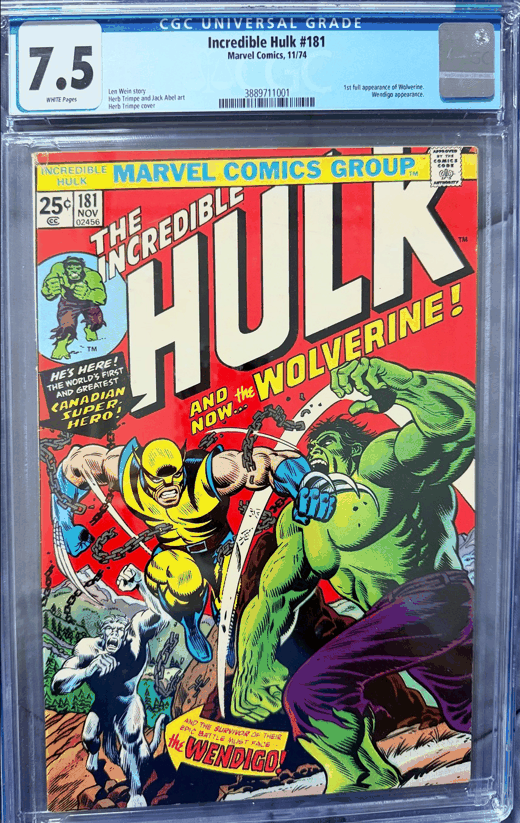
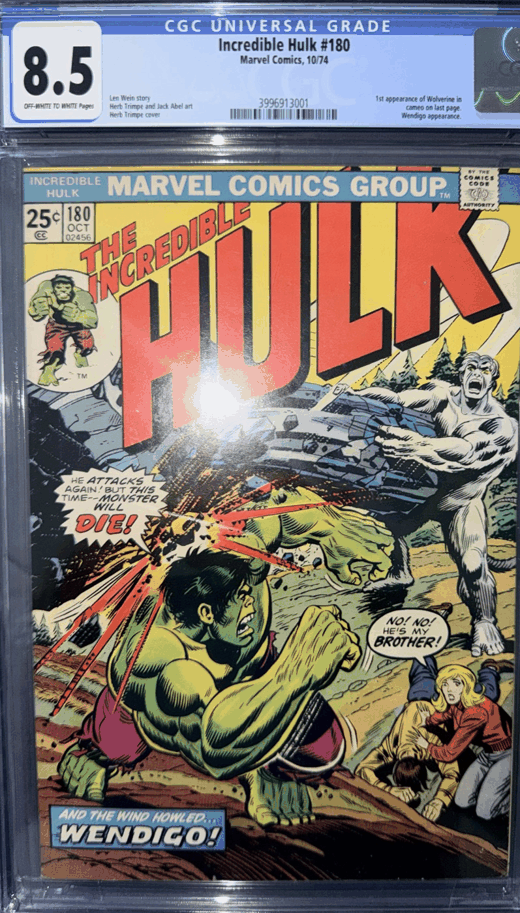
First, the fight on the cover. The Hulk against a white-furred creature called the Wendigo, in the Canadian woods, and a third figure in yellow and blue coming in low with his claws out. Readers had met him one issue earlier, in the last panel of number one hundred and eighty, already in costume and already saying his name. Here he gets the whole story and the cover. He is a Canadian agent sent to bring the Hulk down, and this is still the Hulk's book. He is a guest in it.
That last panel is where an argument starts, and collectors have been having it for fifty years. Is Wolverine's first appearance the issue where he shows up, or the issue where he does something? The grading company splits the difference on its labels. The label on one hundred and eighty says first appearance of Wolverine, in cameo, on the last page. The label on one hundred and eighty-one says first full appearance. The market has picked a side. In the same grade, one hundred and eighty sells for a fraction of what one hundred and eighty-one brings, for one panel's difference. Keep that in mind. This is a hobby that puts a price on the difference between arriving and acting.
He came out of ordinary work. Roy Thomas, the editor, has said he asked for a Canadian character and gave him the name Wolverine. Len Wein wrote him. John Romita, the art director, designed the costume, and the claws were first meant to be part of the gloves. Herb Trimpe had been drawing the Hulk since 1968, and he drew this one, the first time anyone saw the character move. Fifty years on, the credit for him is still argued over. In 1974 it was a month's assignment.
Now the stamp. In 1974 Marvel ran a promotion across its comics: a small picture printed on an inside page, one hundred of them in the first series, and a booklet you could send for and paste them into. In this issue the stamp is number fifty-four, Shanna the She-Devil, who has nothing to do with the story. To put her in the booklet you had to cut her out of the comic. Completing one collection meant putting a hole in another.
So imagine buying this issue in the summer of 1974. The reader is invented, and so is the choice. The book is real. The booklet is on the desk. The scissors are in the drawer. You can cut the stamp, or you can leave it. Choose now.
Readers did cut these stamps. Nobody counted how many. One dealer wrote, in 2019, that copies of this book came to him with the hole more often than not, and that is one man's mail, not a census. Hold on to your choice. It pays off at the end, when two labels say the same number and mean two different things. Before that, there is the man who drew the fight, and what happened to him has nothing to do with stamps.
Herb Trimpe drew for Marvel for close to thirty years. In 1996 the company cut its staff and his time there ended. He was in his fifties. He went back to school, and he became a public school art teacher, and in the year 2000 The New York Times printed pieces of the journal he kept while he did it, under the title Old Superheroes Never Die, They Join the Real World. Here is the second choice, and this one has a true answer. After the classroom, did Herb Trimpe ever draw comics again?
He did. He went to conventions, took commissions, and worked in comics again before he died in 2015. The book he drew in 1974 sat in plastic on collectors' shelves, kept from changing. The man who drew it kept changing for the rest of his life.
Now the label. Today a comic like this goes to a grading company, gets a number on a scale that runs from half a point to ten, and is sealed in plastic with a label. A copy with a significant piece missing, like a cut-out stamp, can come back with a green label and the word Qualified. The number on that label sets the missing piece aside. So two labels can both say seven point five and describe two different books, one complete and one with a square cut from a page. The green one usually sells for less. How much less depends on the day and the buyer. There is no fixed rule.
At the top of the scale the prices are the ones people repeat. CGC reported that the single highest copy it had graded, a nine point nine, sold in 2011 for one hundred and fifty thousand dollars. That was one sale of one book. The copy on your screen is graded seven point five, and it belongs to the creator of Pocket Dread, who owns the issue before it too. Both were photographed by him and catalogued in Collectibles Atlas, which read the labels you have been looking at. We do not know who owned it in 1974 or what they did with their scissors. Your choice cannot tell us that. It can tell you what the choice was. Now compare the two outcomes.
A reader who cut the stamp finished a page in a booklet. A reader who left it kept a comic whole, without knowing that anyone would ever care. Fifty-some years later, the people who care pay more for the whole one. That is what a price can tell you: what the buyer today wants to preserve. It cannot tell you what the first reader enjoyed, and it says nothing about the working life of the man who drew the fight. Some things get sealed in plastic. Some things have to keep moving.
This has been Hulk 181 Origins, a Pocket Dread story, told with two comics from the shelf of the person who makes Pocket Dread, with their records drawn from Collectibles Atlas. The reader and the choices were imagined. The narrator is an AI voice. Every screen was authored, and nothing read your phone. Good night.
The words as narrated. Records from Collectibles Atlas. The narration is a synthetic voice.