Read the story
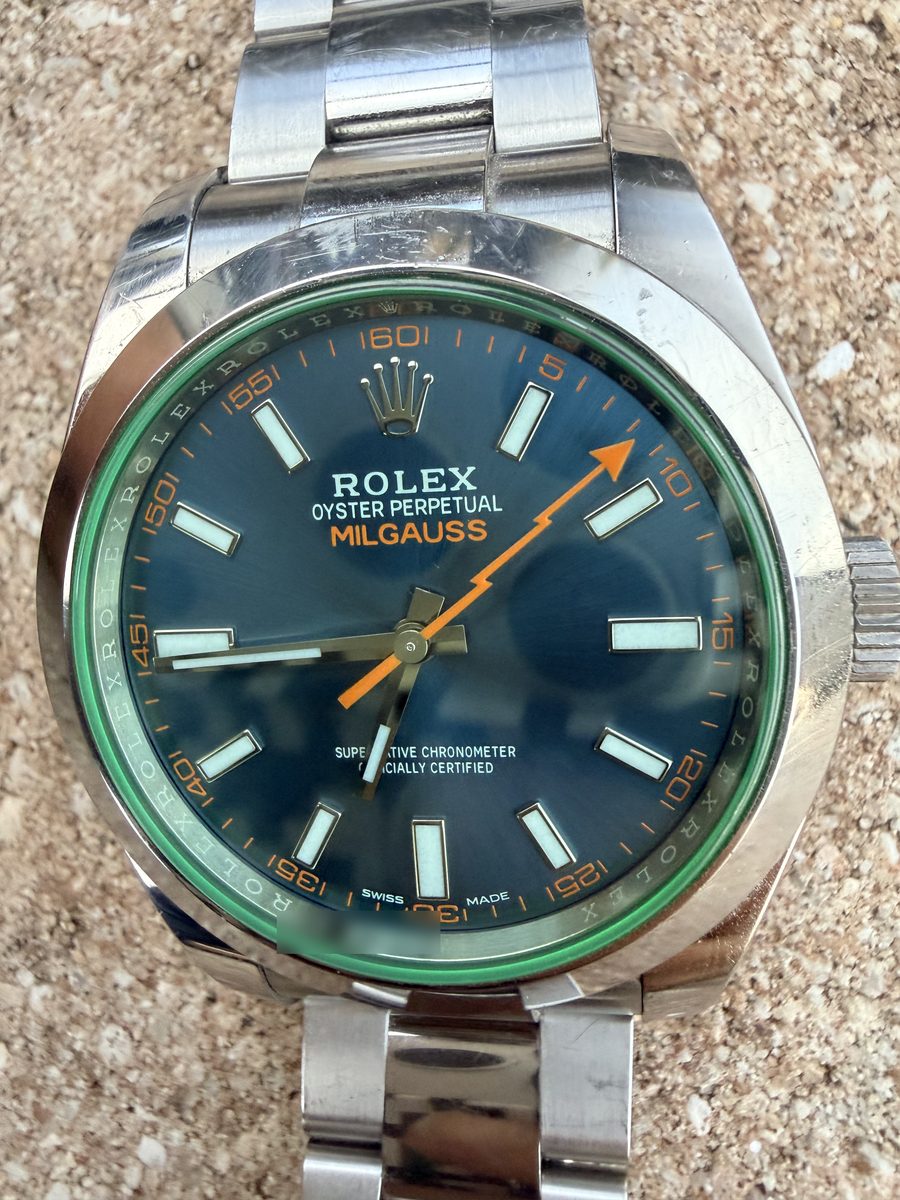
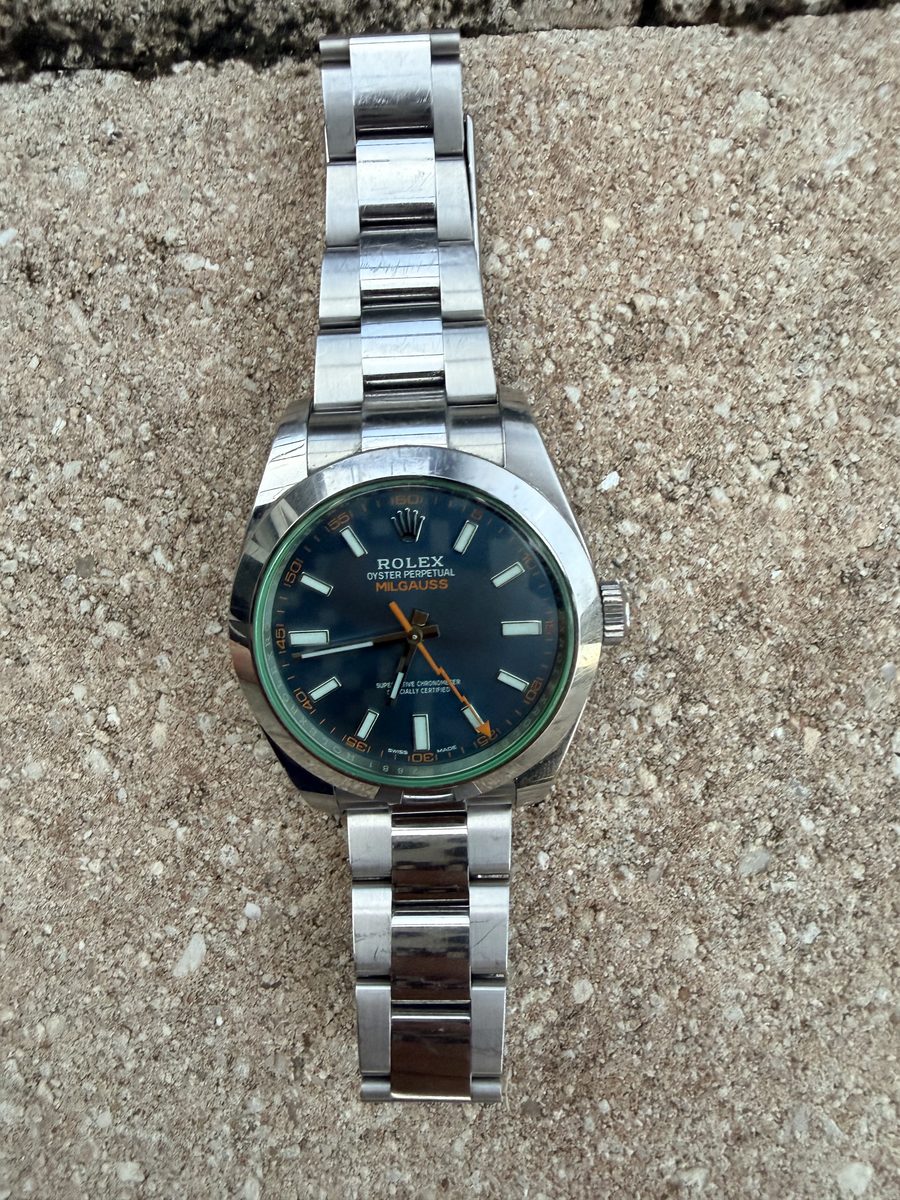
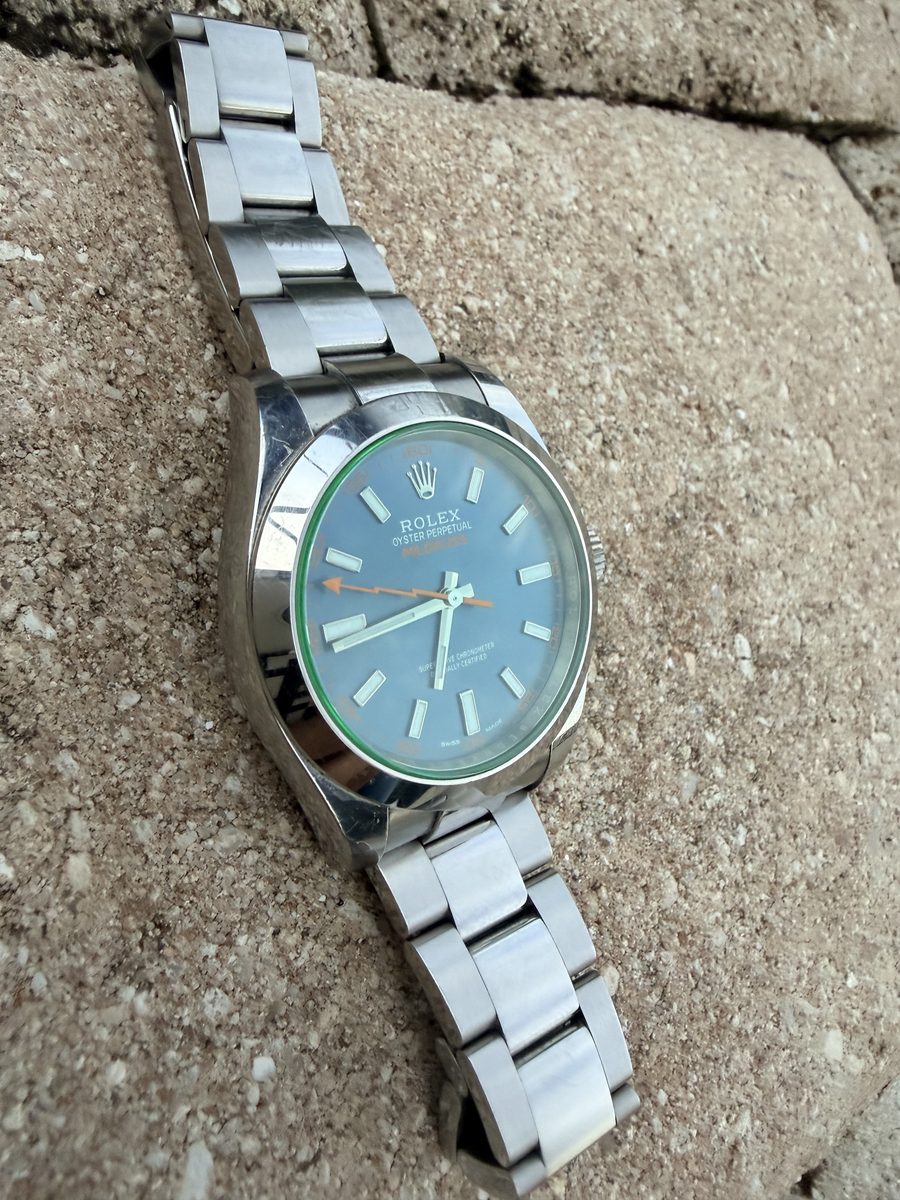
There is a watch that was built to work in a room where watches stop. It has a lightning bolt for a seconds hand and a sheet of green glass over its face, and the company that made it for sixty-odd years stopped making it two summers ago, without saying why. This one belongs to the person who makes Pocket Dread. Before we are done you are going to walk into that room with it, and you are going to decide whether to leave it in the locker.
First, the problem. A mechanical watch keeps time with a hairspring, a coil of metal about the width of a hair, breathing in and out about eight times a second. Put it near a strong enough magnet and the coils of that spring stick to each other. The spring gets shorter. The watch does not stop. It runs fast, minutes a day, and it keeps running fast after you walk away, because the steel remembers the magnet. That is the quiet version of the problem. The loud version is a laboratory in Geneva in the nineteen-fifties, with magnets big enough to bend a beam of particles, and a staff of physicists whose watches had all gone wrong.
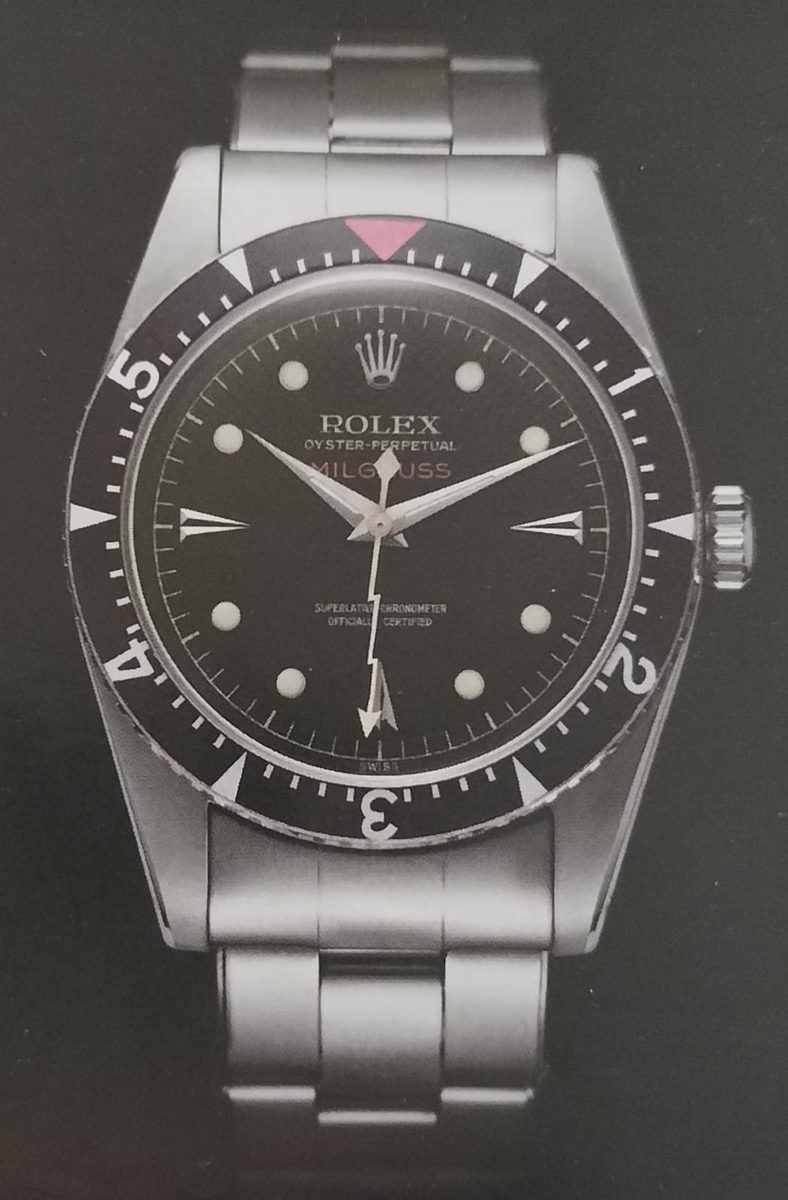
The story Rolex tells is that the laboratory asked for a watch. The laboratory was CERN, the European center for nuclear research, and in 1956 Rolex answered with the Milgauss. Mille gauss. A thousand gauss, the unit of a magnetic field, which was the strength it was guaranteed to shrug off. Inside the case they put a second case, a soft iron shell around the movement, a cage that lets the field flow around the works instead of through them. A physicist would call it a Faraday cage. The catalogues called it nothing. It was just inside. Here is the first thing worth knowing about this watch: CERN has never confirmed that story. It is on every dealer's page and in every auction essay, and the laboratory that is supposed to have asked for it has never said so in public. A watch built for a room, and the room does not remember asking.
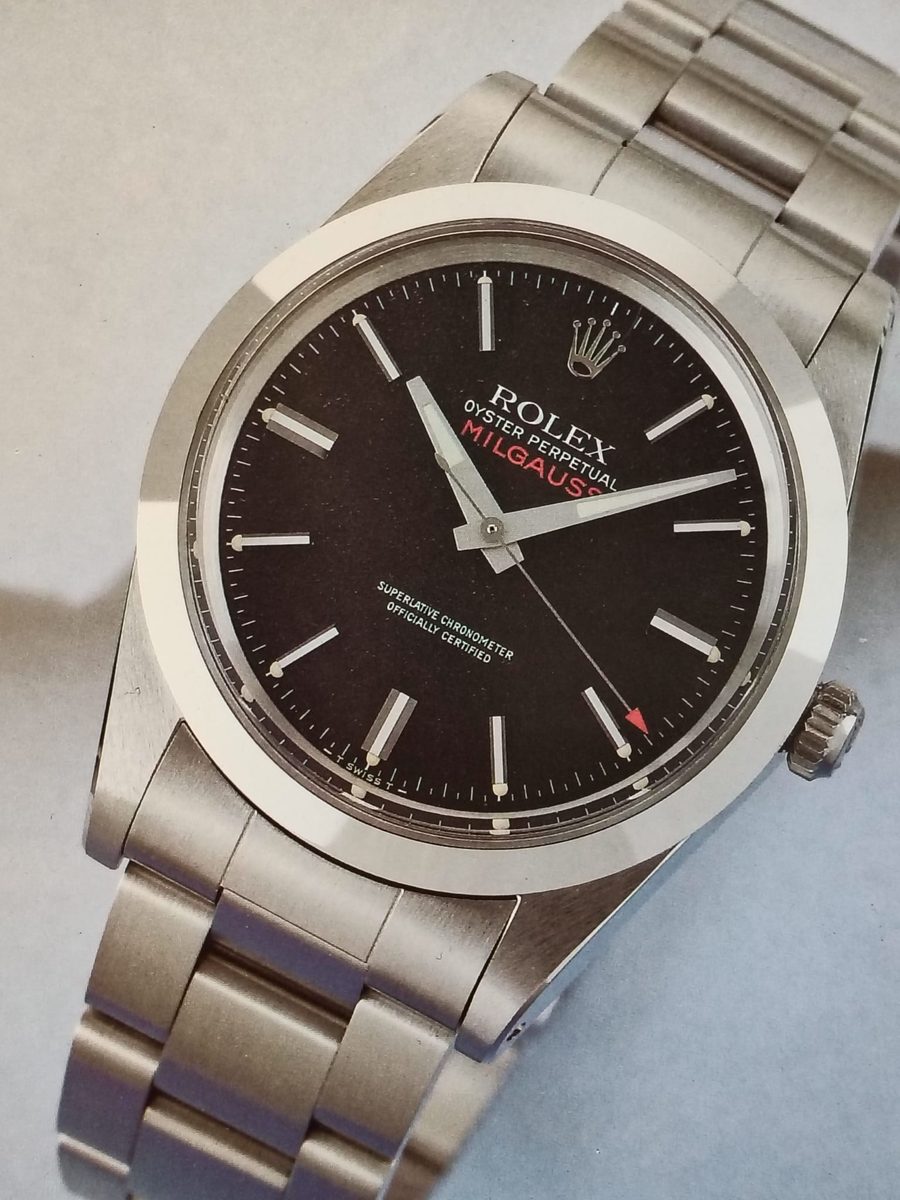
The first proper one is reference six five four one. Steel, a rotating bezel cut into six sections, a dial patterned like a honeycomb, and that seconds hand, a jagged bolt of lightning sweeping around once a minute, which is the only part of the watch that admits what it is for. Rolex made very few. The auction houses say fewer than two hundred of the first two references in four years, because the market was a few hundred people in lab coats and the watch was expensive. It was a tool, sold to the people who needed the tool, and most of them wore it to work.
Now the room. It is 1958. You are invented, and so is the morning, but the machine is real. You are a physicist in Geneva and you have been issued one of these. The magnet hall is through the next door. Your ordinary watch, the good one your father gave you, is in the locker, because you learned the hard way. The Milgauss is on your wrist. The engineers say it will be fine. The engineers are not wearing one. Do you wear it in, or does it go in the locker with the other one? Choose now.
Hold on to that. It pays off at the end, when two watches come out of the same room and only one of them is still telling the truth. Before that, the years in which nobody wanted this watch at all.
In 1960 Rolex replaced it with a plainer one, reference one zero one nine. The honeycomb went. The lightning bolt went. It looked like a dress watch that happened to be able to walk through a magnet, and it stayed in the catalogue for twenty-eight years. There was a version with no glow on the dial at all, made for the laboratory, because the paint that glowed in the dark was mildly radioactive and the instruments in that building could tell. A watch so careful about the room that it gave up being readable at night. In 1988 Rolex stopped making it. Not with an announcement. It simply was not in the next catalogue. For nineteen years there was no Milgauss.
It came back in 2007, for its fiftieth birthday, and the version that mattered had something no Rolex had ever had and none has had since: a crystal tinted green. Glace verte. Green glass. The company is said to have found the tint so difficult to make consistently that it did not bother to patent the process, on the theory that nobody else could do it anyway. That is a story too. Believe it as much as you believe the other one. In 2014 the dial under the green glass turned an electric blue, and that is the watch on your screen. The lightning bolt came back, in orange. The iron cage is still in there. The hairspring is now an alloy of niobium and zirconium that a magnet cannot hold, so the cage is protecting something that no longer needs protecting, which is a very Rolex way to build a watch.
In the spring of 2023, in Geneva, one of the first ones, a six five four one from 1958 with its box and papers and a honeycomb dial that had not aged, came up at auction. The estimate was half a million to a million francs. It sold for two million two hundred thirty-eight thousand. Two and a half million dollars. Here is the second choice, and this one has a true answer. The press reported that the price doubled because of one underbidder who would not stop. Who was on the other end of that bidding war?
Rolex. The reports say the company itself was bidding, trying to buy back one of the watches it had built for a room it says asked for it, and a collector in America outbid them. Two months before that sale, at the industry's spring fair, Rolex had quietly taken the Milgauss out of the catalogue again. No announcement. Not in the book. The company stopped making the watch, and then tried to buy the first one back, and lost.
So the watch on your screen is one of the last. Steel, green glass, blue dial, a cage of iron around a spring that does not need it, and a lightning bolt going around once a minute. We do not know who will wear it in fifty years, or what room they will walk into. Your choice cannot tell us that. It can tell you what the choice was. Now compare the two mornings.
If you wore it in, it worked, the way the engineers said, and you spent the morning glancing at it, and at the end of the day you compared it with the clock in the hall and it was right, and the watch in the locker was right too, because it never went near the magnet. If you left it in the locker, both watches were right, and you never learned anything, and you carried the good one the rest of your life without knowing whether it would have held. That is what a tool can tell you. It can tell you it worked. It cannot tell you what would have happened to the other one. Some things get tested. Some things only get trusted.
This has been Rolex Milgauss Origins, a Pocket Dread story, told with one watch from the shelf of the person who makes Pocket Dread, its record drawn from Collectibles Atlas. The physicist and the mornings were imagined. The narrator is an AI voice. Every screen was authored, and nothing read your phone. Good night.
The words as narrated. Records from Collectibles Atlas. The narration is a synthetic voice.