Read the story
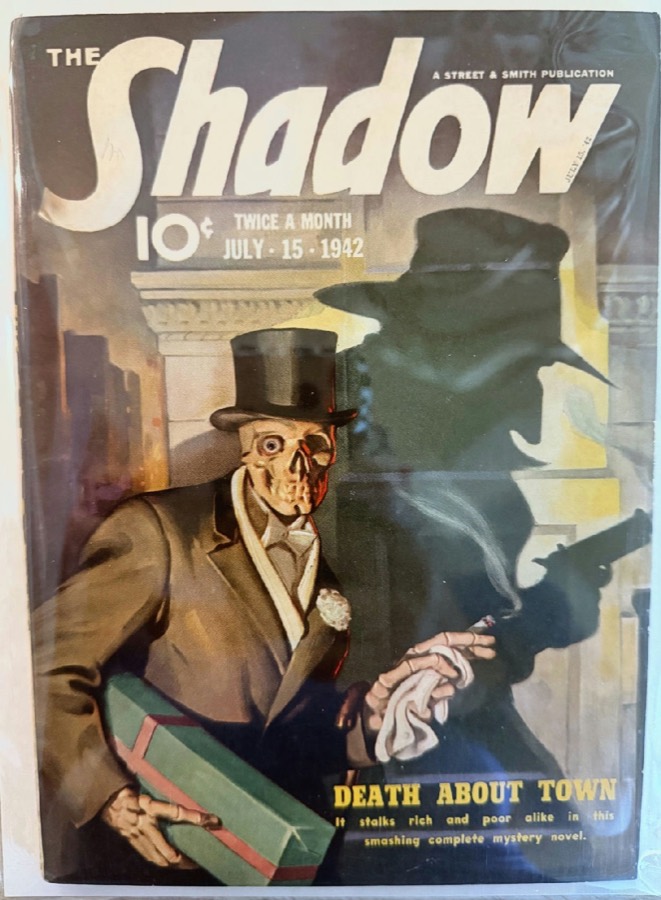
This cost a dime in the summer of 1942. It is The Shadow, from Street and Smith, and the cover says the rest itself: twice a month, July fifteenth, ten cents. Today it belongs to the creator of Pocket Dread, and it is catalogued in Collectibles Atlas, which is where the record on your screen comes from. Look at the edges first. Cheap wood-pulp paper goes brown and brittle as it ages, and a chip at the edge takes a piece of the painting with it. Keeping a story and keeping the object it came in are two different achievements, and the second one is where the money is. A graded copy of this issue, a 3.5 on a ten-point scale, which is low, sold this year for six hundred and fifty dollars. It cost ten cents. Everything here was printed to sell from a rack, and Congress eventually took an interest in what the covers were doing. That is the thread through these nine objects: what a cover promised, what it hid, and what is left of it now.
In 1939, Pocket Books put ten titles on sale at a quarter each, small enough for a coat pocket. A whole book, competing for the pulp reader's dime. On the eighth of April, 1949, Street and Smith announced the end of four of its pulps: The Shadow, Doc Savage, Detective Story, and Western Story. Other pulps went on, but the magazine on your screen had seven years left when it was printed. Then, in 1952, a House committee chaired by an Arkansas congressman named Ezekiel Gathings held hearings on what it called current pornographic materials, and it looked at paperbacks, magazines, and comics together. Here is the first question. Did the committee object to the words inside the books alone, or to the words and the covers both?
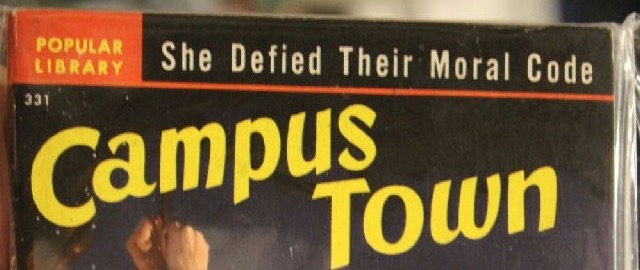
Both. The committee's report went after the writing inside the books and the paintings on the outside, and it noticed what collectors have known for a long time: a cover could promise more than the story inside it delivered. A cover was a sales pitch. This is Campus Town, by Hart Stilwell, from Popular Library, 1951, number 331, with a cover attributed to Earle Bergey, because the painter is part of the object's history the way the author is. The painting is the kind the committee had in mind, and you are seeing the title band, not the whole of it. On a copy like this, look at the light areas of the painting and at the gloss. Rubbing shows there first, and a scuff in the whites changes what the painting looks like.
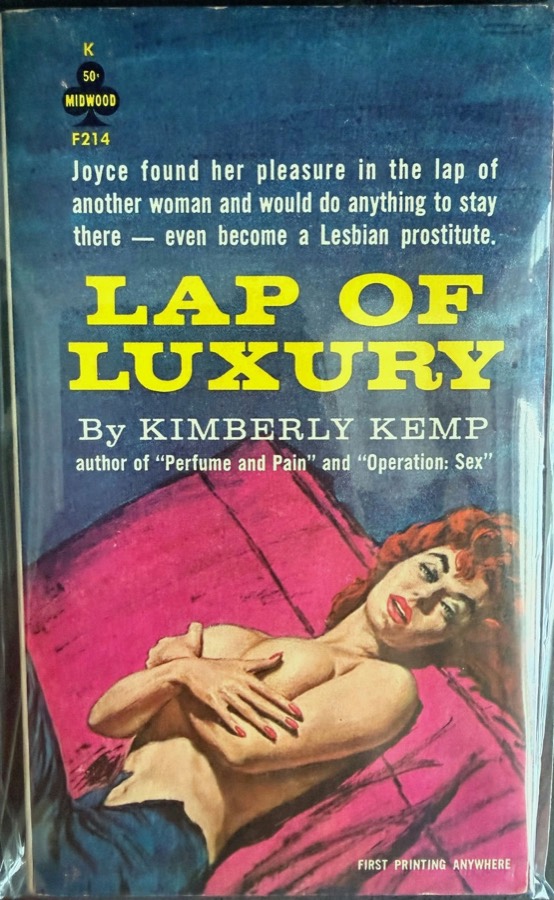
Women's Barracks, a novel Tereska Torrès drew from her own war, came out from Gold Medal in 1950 and sold in the millions. It opened the door to what the trade called lesbian pulp. Many of those books gave their women bleak endings, though not all of them did. Ann Bannon's first novel appeared in 1957, and she has said that the letters women wrote to her told her what the books were for. This is Lap of Luxury, from Midwood, 1962, fifty cents, F214, and the cover says First Printing Anywhere. The byline is Kimberly Kemp. The same packaging could hold very different writers, with very different ideas about who was reading. On a Midwood, look at the glossy wrapper for creases, and at the hinge, where the gloss cracks first. A Very Good copy of this fifty-cent book asks about a hundred and seventy dollars today. Here is the second question. Was Kimberly Kemp the writer's given name, or a pen name?
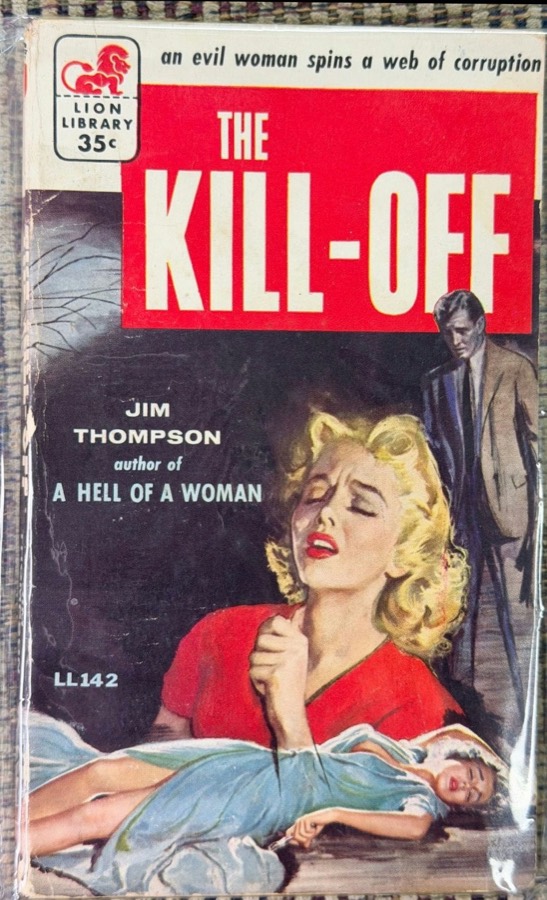
A pen name. Kimberly Kemp was a name used by a writer called Gilbert Fox. The byline told the buyer nothing about who was behind it. That is a fact about the packaging, not about what the book meant to the people who read it. Here is a different kind of promise. In 1950, Gold Medal helped build a market for paperback originals: novels written for the rack, with no hardcover first. Jim Thompson wrote crime novels for Lion, starting with The Killer Inside Me in 1952. This is The Kill-Off, a paperback original from Lion Library, 1957, thirty-five cents, LL 142. The first edition of this novel is a rack book. On a Lion, look at the spine: creases, lean, and splitting at the hinges are what separate one copy of this edition from another. Dealers grade these books Good, Very Good, Fine, and Very Fine, and the words carry the price. For this one they ask fifteen dollars for a Good copy and three hundred and fifty for a Fine one. Same book, thirty-five cents new.
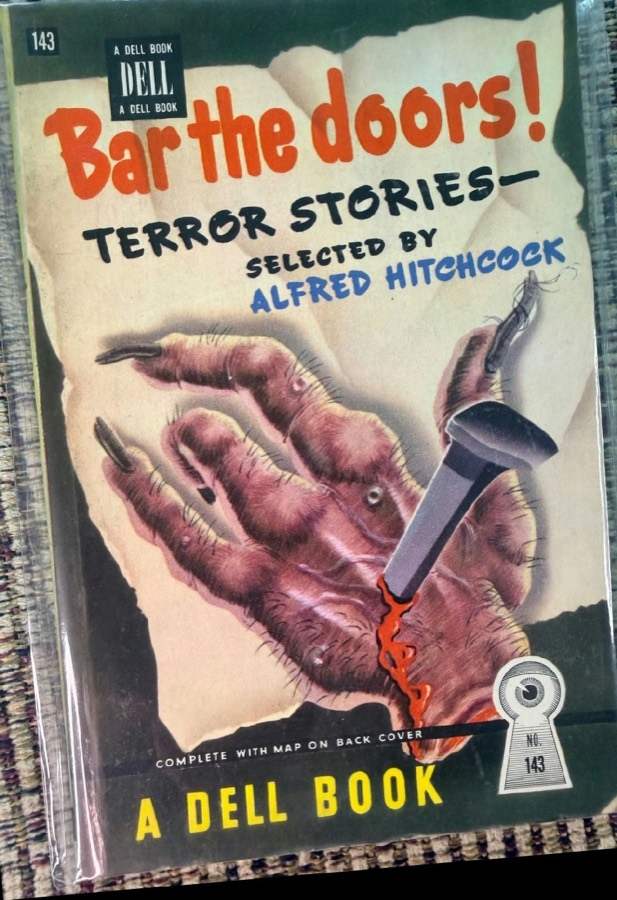
Dell made the back of the book part of the pitch. Collectors call these mapbacks, and their main run went from 1943 to 1951: a map or a diagram on the back cover, tied to the story inside. Ruth Belew was an important artist behind those backs. This is Bar the Doors, Dell number 143, 1946, terror stories selected by Alfred Hitchcock, and the front cover says it plainly: complete with map on back cover. A mapback gets the same condition check on both faces, because rubbing on the back takes away the second design.
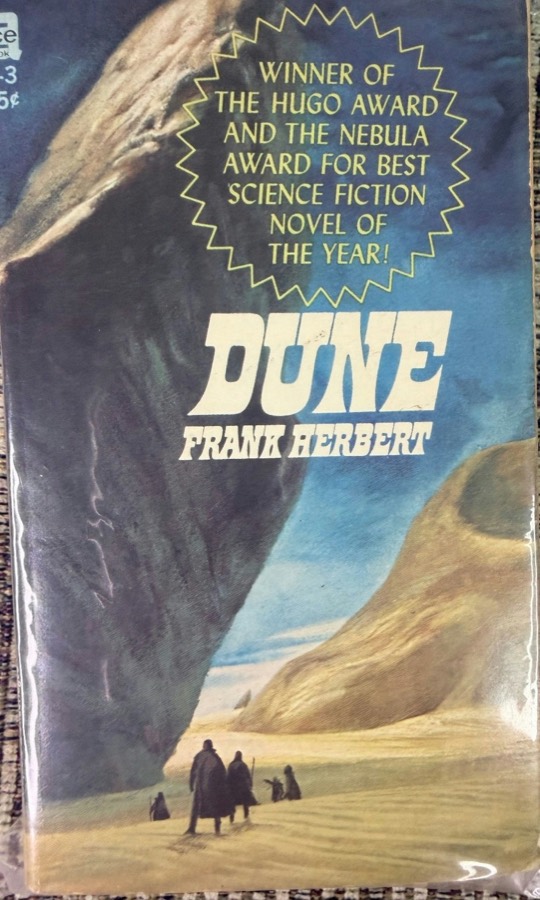
Some quarter books outgrew the quarter. Dune found its first book publisher in Chilton, a company known for auto repair manuals, after other publishers turned it down. An editor named Sterling Lanier championed it, and the hardcover appeared in 1965. Ace put out this paperback with a John Schoenherr cover, and the paperback made a long novel into something that still fit in one hand. On a spine this thick, look at the joints for reading creases and separation, and do not force the book flat to check. The copyright page gives you a year. Which printing you hold takes more than that to know.
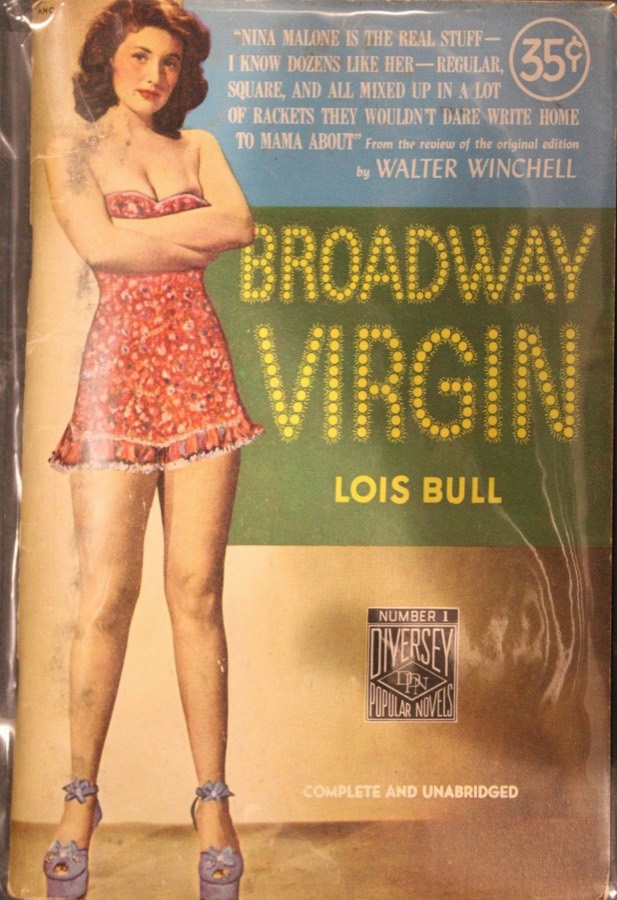
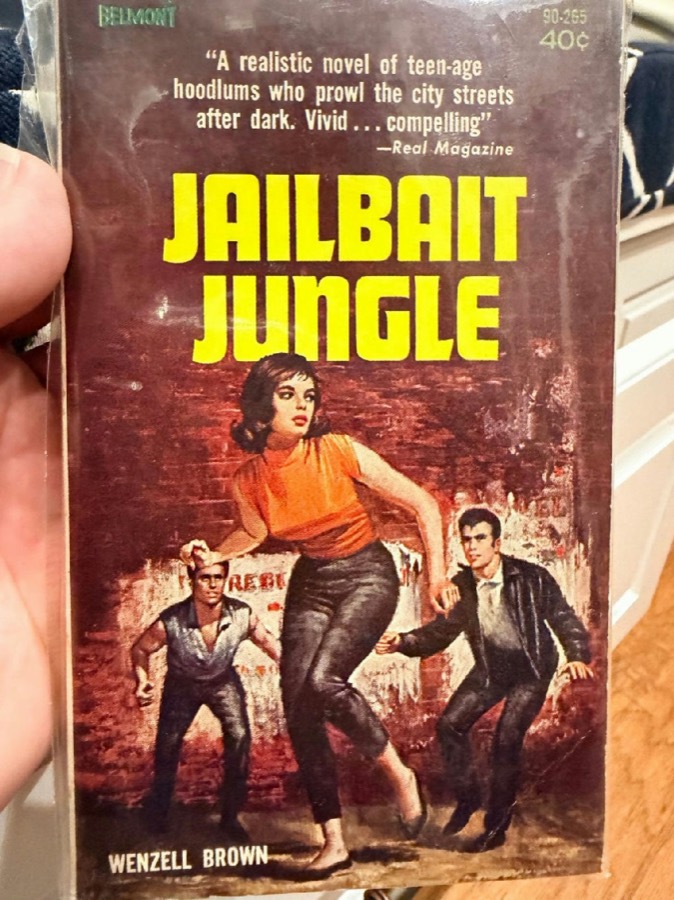
Fear about young people sold books too. In 1954 the Senate held hearings on comic books, and the comics industry wrote itself a code that same year, a separate episode from the House inquiry two years before. Broadway Virgin is a digest from 1949, by Lois Bull, number one in Diversey's Popular Novels series, thirty-five cents. Diversey had put out Reform School Girl the year before, in a different series. On a digest like this, check the staples and the fold for rust, tears, and separation. Beside it is Jailbait Jungle, by Wenzell Brown, from Belmont, 1962, forty cents. On that one, look at the edges of the wrapper for losses, and at the spine joints for splits. Thirteen years apart, the same anxiety, sold in a new package.
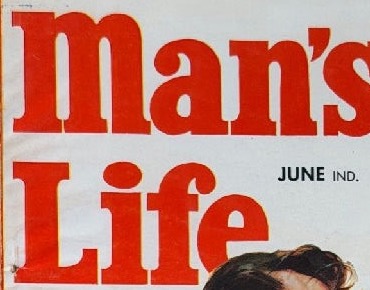
Then the magazines that came after the pulps, the ones the trade called the sweats. Men's adventure magazines took shape in the late nineteen forties and ran into the seventies. A September 1956 issue of this title, Man's Life, ran Wil Hulsey's painting of a man attacked by weasels, and in 1970 its headline became the title of a Frank Zappa and the Mothers of Invention album. This issue, June 1959, is from the strain that turned Nazi torture into entertainment. That exploitation is part of the publishing history, and you are seeing the masthead and the date, not the painting. On a magazine, condition starts at the staples, where the cover pulls free and tears run into the paper. A cover like this is evidence of what a publisher thought would sell.
Nine objects have taken us from a dime magazine to the paperbacks and back to the magazines. Every one of them made a promise to somebody walking past a rack. Choose Show the shelf to see them together, or wait, and the shelf will come on its own.
These are things somebody kept. Paperbacks still go out with the trash before the estate sale, boxed with the magazines, because nobody in the house knew what was on the shelf. There is real value in a paperback in good condition, and the difference between a Good copy and a Fine one is the difference between a box at the curb and a book a dealer wants. Collecting starts with knowing what the object is, then looking closely enough to see what has survived. Condition matters because damage changes what is still there to study and enjoy, and because it changes what the book is worth. Every object here belongs to the creator of Pocket Dread, and every one is catalogued in Collectibles Atlas, which is where the records on your screen came from. This story draws on collector Lowell Wilson's notes on these copies, alongside published histories of the books and magazines. The value of this shelf is that the history is still here to be looked at.
This has been a Pocket Dread story. The voice is an AI narration. Every screen was authored, and nothing on this page read your phone. Good night.
The words as narrated. Records from Collectibles Atlas. The narration is a synthetic voice.